
How to Create A Quarterly Plan That Grows Your Business
How my quarterly plans used to play out:
Month 1 - “This is the quarter I become rich.”
Month 2 - Stares blankly at computer screen
Month 3 - “Never mind, maybe next quarter.”
Then I created a simple, three step process for quarterly planning that actually works. It’s helped me generate $1.5m+ in coaching and course sales over the years.
In this article, I’m going to walk you through that process step by step.
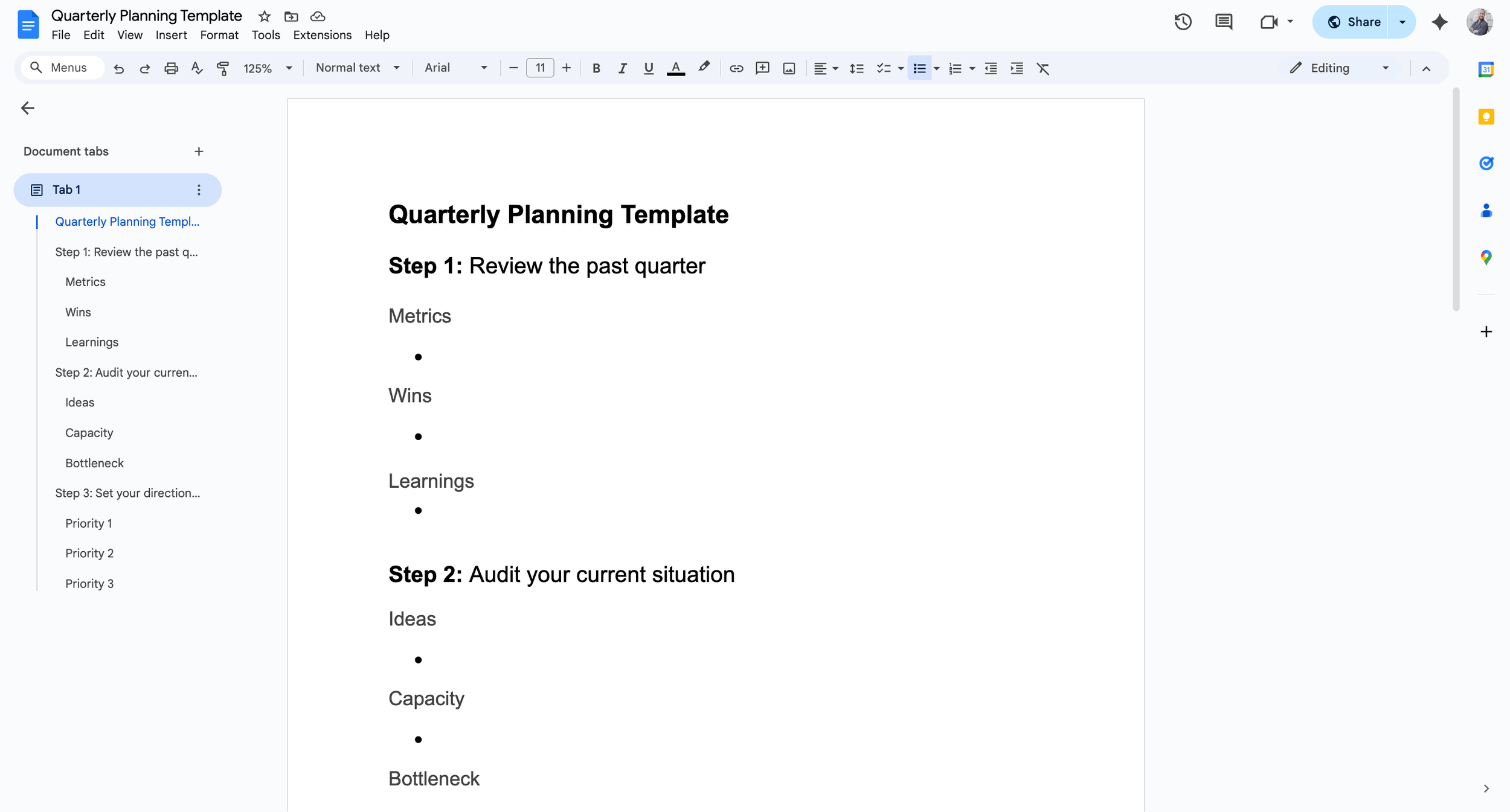
If you want to follow along, click the button below to download my Quarterly Planning Template - a one page Google Doc you can copy and fill in.
Let’s start with the basics.
What Is Quarterly Planning And Why Is It Important?
Quarterly planning is a process of reviewing the previous quarter and setting goals for the next one. It typically happens at the end of December, March, June, and September in preparation for the coming quarter.
Your quarterly plan gives you direction, motivation, and accountability - things that are often in short supply for entrepreneurs. It’s an opportunity to step back, be your own boss, and tell your worker self what to focus on for the next few months. If you have a team, your quarterly plan tells them how to invest their time and energy.
The final output of this plan is a list of 1-3 goals. These goals are not just interesting ideas. They are a set of hypothesis that you have developed in order to address the biggest challenges in your business right now. The outcome of those experiments, plus the new opportunities that arise, help inform your plan for the next quarter.
Let me show you what I mean.
The 90/90 Method For Quarterly Planning
You’re going to block off 90 minutes to plan the next 90 days. Turn off your phone, go to a coffee shop, tell your partner and kids they’re dead to you. Then spend 30 minutes on each of the following three steps. This forces you to focus and avoid perfectionism.
Step 1: Review the past quarter
Before you look ahead, take 30 minutes to look back at your metrics, wins, and learnings.
Metrics:
If you keep a running dashboard of KPIs, now is a good time to update and review those. For example:
New applications
Sales calls conducted
New clients
Close rate
Cash collected
Client renewed
As you record these metrics, flag any outliers. For example, if your close rate is less than 25%, that should inform your plan for next quarter. If you got a lot of great leads, figure out where they came from and double down on that.
Wins:
If you made a plan for last quarter, start there. Which goals did you accomplish? You can also look at your calendar, your to-do list, or your weekly/monthly reviews to find other things that went well. You’ll be surprised by how much you got done.
Learnings:
For the goals you didn’t reach, write down what you learned as a result. That way, you don’t keep making the same mistakes quarter to quarter. Then list any other learnings you had over the last 3 months.
Step 2: Audit your current situation
Now it’s time to take stock of the present. Spend 30 minutes getting everything out so you know what you’re working with. This ensures that your goals aren’t set in isolation.
Ideas:
List any projects, partnerships, or opportunities that you’re considering for next quarter. Which ones feel most aligned with your longer-term vision? Which are you most excited about? The idea here is just have a big brainstorm you can pull from.
Capacity:
Are you feeling motivated or demotivated right now in your business? Reflect on what’s giving you energy versus what’s draining you. Any big life events coming up that you need to account for?
Then look at your calendar for the next 3 months and figure out when you’re taking time off and how that might impact your plan. I like to schedule at least one week off per quarter.
Finally, look at where your cash reserves are at. Do you have the runway to focus on longer term strategies, or are you in a cash crunch that you need to solve now?
Bottleneck:
Identify the main bottleneck that’s preventing growth. What’s the one problem that, if solved, will have the biggest impact on the business? Your metrics from Step 1 can be helpful here. For example:
Execution: “I know what to do, but I’m not doing it consistently.”
Offer: "I'm not clear on what I want to sell next or who it's for."
Leads: “Not enough of the right people are finding + following me.”
Conversion: "I'm getting leads, but they're not turning into clients."
Delivery: “I’m busy with clients, but I can’t ensure quality at scale.”
Step 3: Set your direction for next quarter
Finally, take 30 minutes to set your priorities for the next quarter.
Goals:
Pick 1–3 clear goals. If you’ve done a good job with Step 1 and 2 of this process, it should be pretty clear to you what areas you want to focus on. You can set goals whatever way works best for you. They can be broad intentions or very specific benchmarks. They key is that you should know whether or not your achieved them. I personally like to set process-focused goals instead of choosing an arbitrary metrics like revenue or email subscribers.
For example, if my big bottleneck was lead flow, here are three goals I might set:
Start weekly YouTube videos to grow audience
Launch quarterly planning offer for past clients
Run paid workshop for audience
Game plans:
Break down each of the above goals into 3-4 actionable steps or milestones. Since you don’t always know exactly what will help you accomplish your goals, I like to think of my goals and my game plan like a set of hypothesis. The goals are what I think are most likely to address my core bottleneck and the game plan is what I think will help me accomplish the goal.
You’re free to adjust your game plan, or even your goals, as you get further into the quarter and learn more about what’s needed. The idea is just to give us a direction to start going in. Write some bullet points under each goal with some next steps.
For example, here is a game plan for the workshop goal above:
Choose topic based on client curriculum, discuss with coach
Finalize pricing, date, and promote to audience
Reach out to partners to promote
Create workshop outline and slides
Quarterly Planning Template
You can draft your quarterly plan using my template - just click the button below and make a copy for yourself:
Each step takes me about 30 minutes and ends up being around one page. So the document should be around 3 pages when you’re done.
Print out that last page for yourself or put your goals up on a whiteboard so they stay front and center. You can also add some key dates to your calendar or tasks into your project manager.
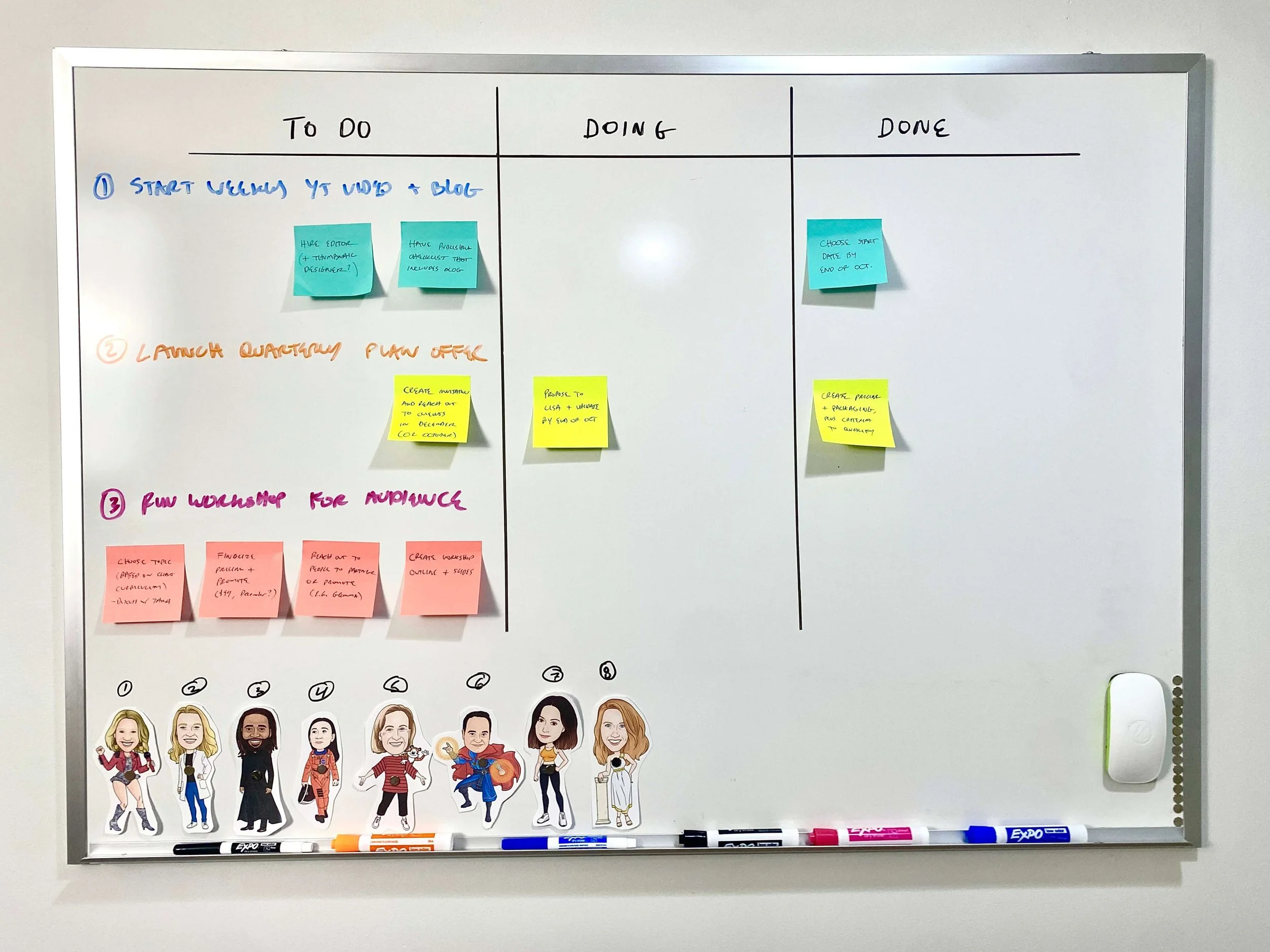
I’ve started using the whiteboard in my office to list my quarterly goals. Each bullet point of my game plan goes on a Post-it note. Then, I move them across the board Kanban style.
If you have a coach or accountability partner, you can have a quarterly meeting to discuss your plan and get feedback on it. If you want my feedback on your quarterly plan, apply for a strategy session with me.
