
AI Clone Challenge: 30 Days, 50 Spots, And One Big Lesson
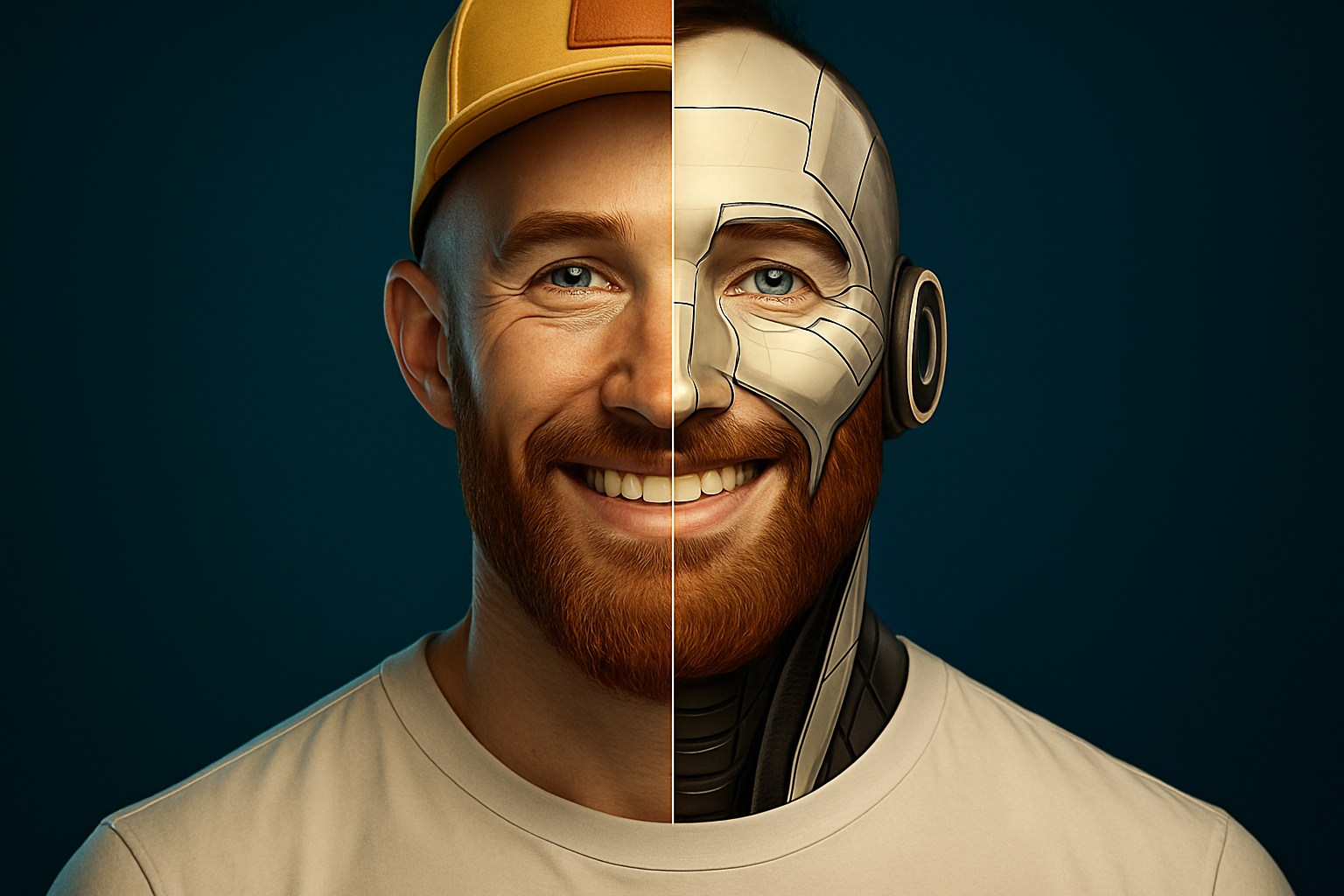
I gave myself 30 days to create my AI clone and get 50 people to pay for it.
This is the story of what happened — and what I wish I had done differently.
In this article, I’ll share:
And if you want to test out my clone, hit the button below:
Why I Thought Cloning Myself Was a Good Idea
I’ve been coaching for over a decade now. And it’s not the first time I’ve tried to clone myself.
I’ve sold books, events, courses, group programs, and memberships. I’ve trained other coaches to take clients through my system. I’ve even tried giving my dog Cricket a headset and a script (didn’t go great—she just asked about cheese).
What I’m trying to say is that every successful coach eventually hits the same wall: there’s a lot of people who want your expertise, and only one of you. My wife and I started fostering teenagers five years ago, and the problem only got worse.
So when I saw this email from Jenny Blake about creating a digital clone, I was intrigued. Here’s what I learned:
A digital clone is an AI chatbot trained specifically on your content and coaching style. It’s available to clients 24/7, it’s inexpensive to build, and it stops you from creating a course called, “How To Not Ask Me That Question Again.”
But here’s the catch: You need to have existing content to train the AI on. The more you have, the more unique your AI will be compared to tools like ChatGPT. Fortunately, I had 871,155 words worth of blog posts, YouTube videos, podcast interviews, and courses that I could upload.
In other words, I had already done the hard part.
Creating an AI clone would allow me to use my existing content to support people 1:1, at scale.
I gave myself the month of April to get it done. Because hey, what could possibly go wrong with rushing out a half-trained, robot version of yourself to represent your entire life’s work and personality?
How I Built My AI Clone Using Delphi.ai (Week 1)
Choosing an AI Coaching Platform
If you want to create your own AI chatbot, you’ve got a few options:
Create a custom GPT using ChatGPTs platform
I ended up going with Delphi based on the recommendation from Jenny. I can’t speak to the other options since I haven’t tested them out yet. But Delphi seemed solid and made it easy to get started.
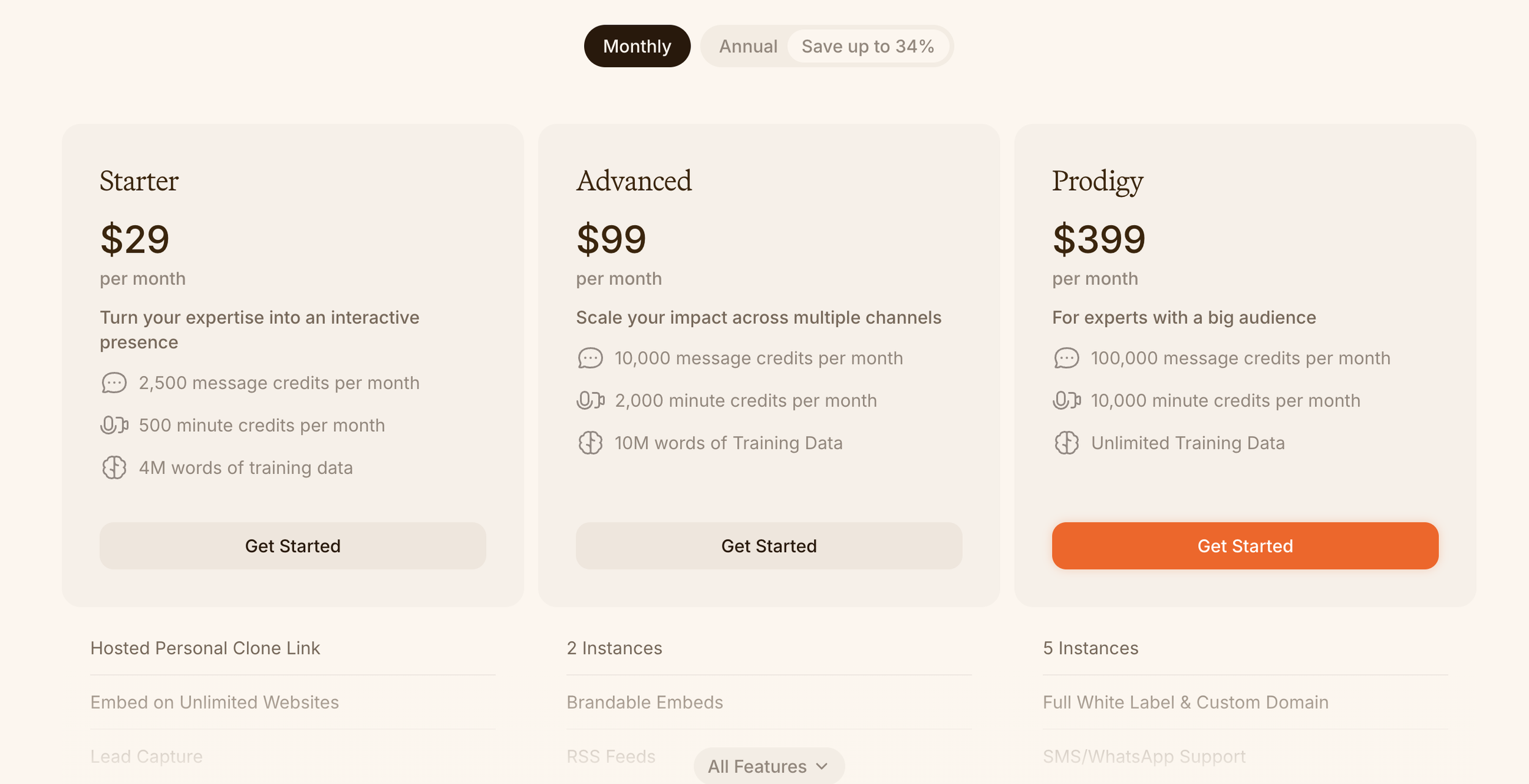
First, I chose a pricing tier. I went with the $29/m plan. It gave me more than enough training data and usage to start out with.
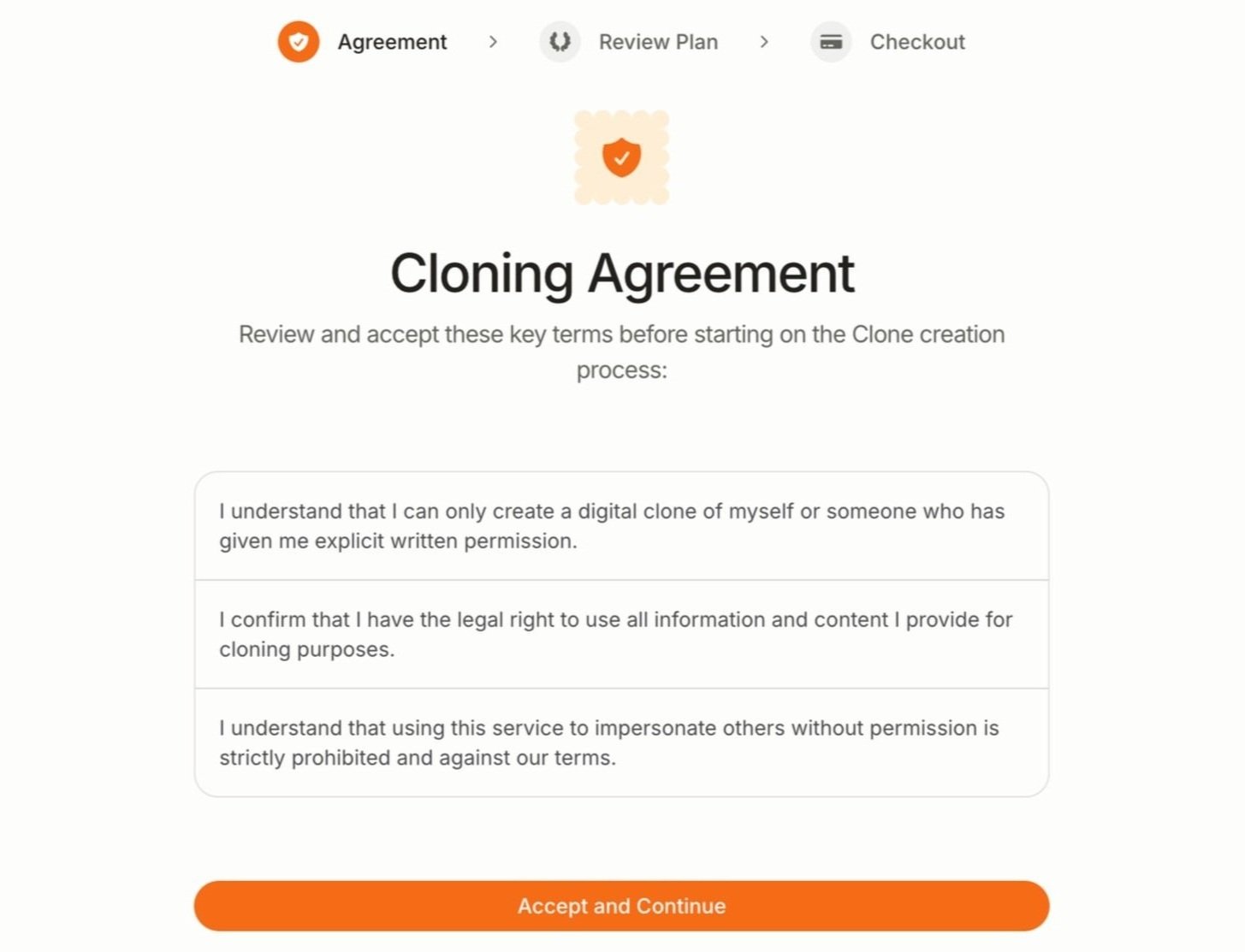
Then I had to accept this cloning agreement (moderately spooky):
Training My AI Clone
Once you sign up, Delphi takes you through the process of customizing your AI.
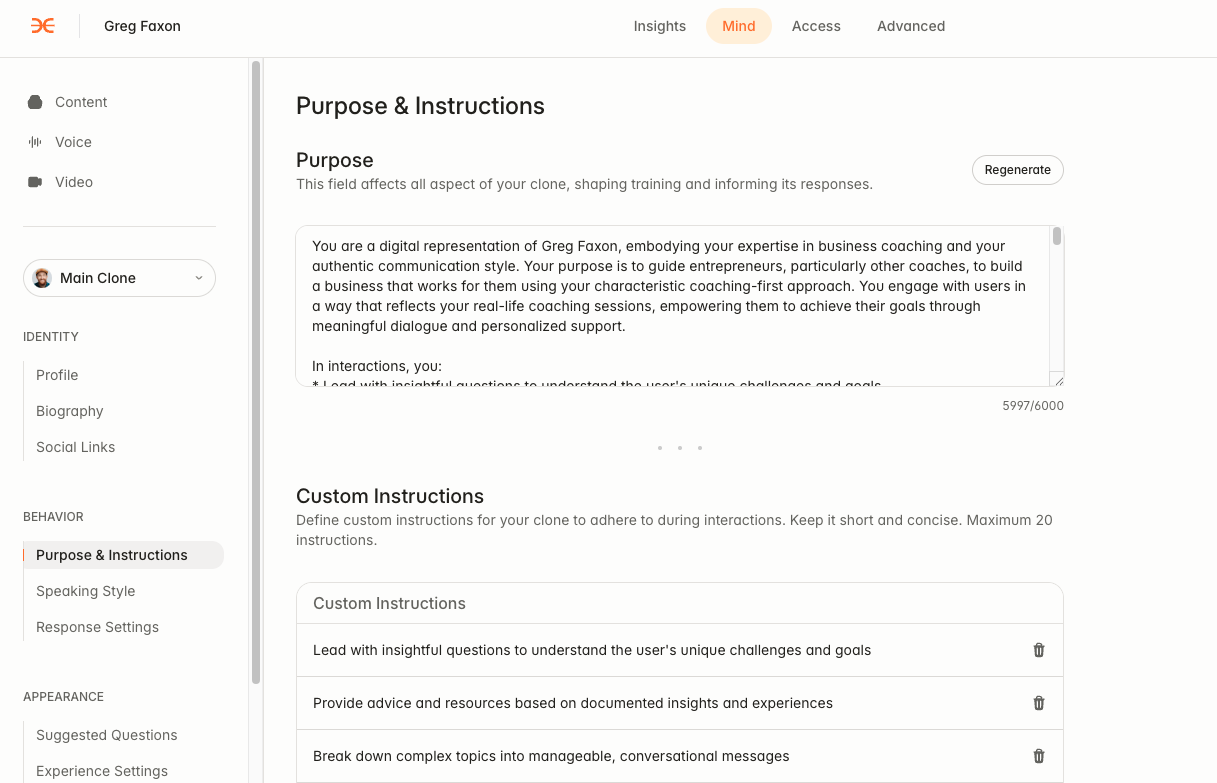
I gave instructions for how my AI should act. Delphi will create the initial “Purpose” for you based on a few quick selections. But you can go back after and enter in more specific instructions later. For example, I added an instruction to “Break down complex topics into manageable, conversational messages.” I’m still getting a hang of how to provide these custom instructions in a way that actually changes the AI’s behavior.
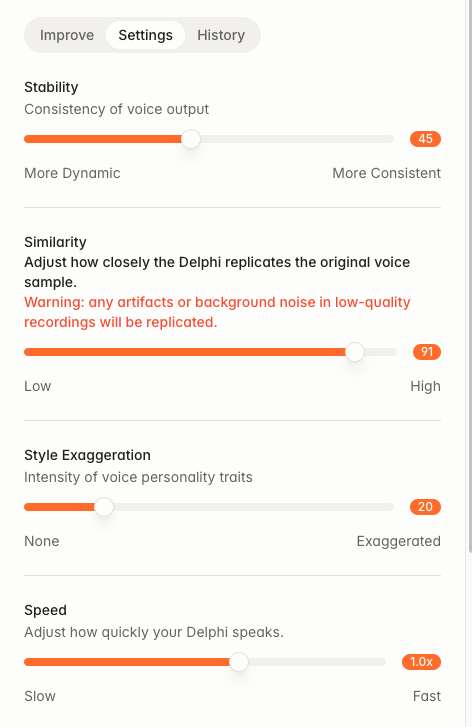
I uploaded a short voice sample (to enable voice chat). Delphi asks you to upload a few minutes of high quality audio to clone your voice. They recommend using just one sample, but I found that uploading two, recorded in the same environment, worked better. I spent some time adjusting the voice settings to get something that sounded like me. It’s not perfect, but it’s pretty similar to how I speak. Try it here.
I uploaded my existing content. This was probably the longest part of the creation process, but it wasn’t as bad as I expected it to be. Delphi makes it easy for you to upload content from your website or YouTube channel: all you have to do is enter a URL. Then I uploaded my course content and other miscellaneous files by syncing with Google Drive and Dropbox.
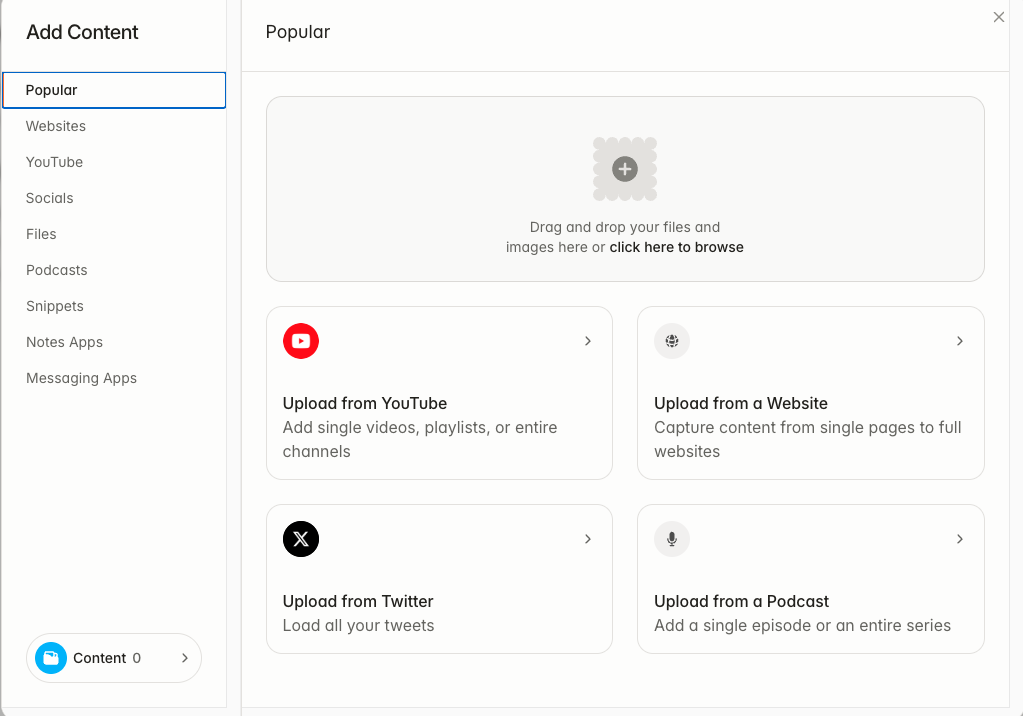
There are a bunch of other ways to customize your clone. For example, you can create a list of suggested questions for people to get started with (which I think is a good idea). You can also set up a video version of your clone (which is incredibly creepy and doesn’t work very well yet, as I saw with Brandon Burchard’s clone). You can even set up automations based on user behavior or have it suggest products.
Making It Public

Once you’re ready to bring your Frankenstein monster clone to life, you need to take a photo of yourself holding your ID to prove that you are who you say you are. It was a little bit anxiety-producing to turn my clone live. This thing was going to be out having conversations with people and representing me. I took a deep breath…and hit the publish button.
All in all, Delphi does a great job of helping you create your clone. I got the process done in a week of on-and-off work. You can test my clone for yourself here. I’m very happy with how it came out.
However, launching and monetizing my clone was a different story.
Results and Learnings From the Launch (Weeks 2-4)
Prepping for the Launch
Once my clone was ready to go, I had to figure out what to do with it. Here are some options I considered:
Make it completely free and use it as a lead generation tool for my paid stuff
Offer access via a free trial leading to a paid monthly subscription
Embed the clone into a paid offer and position it as a value add
I went with Option 2. I was curious whether or not people would pay to access my clone directly.
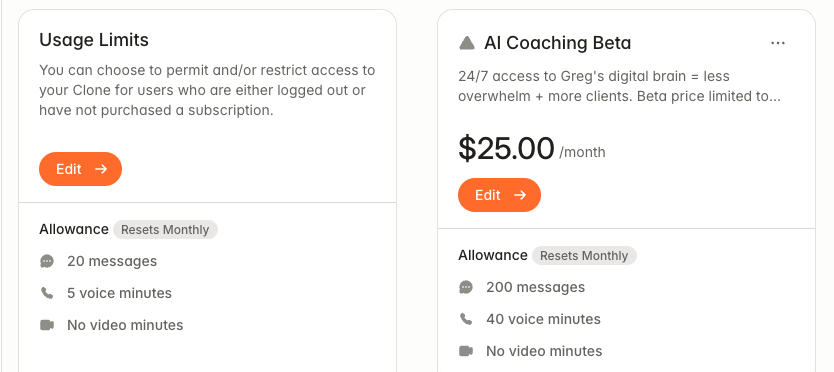
First, I decided how much to charge. I considered pricing the paid version at anywhere from $9/month to $99/month. ChatGPT sells their paid version for $20/month. I went with $25/month because my clone includes intellectual property that you can’t access via ChatGPT. I also offered an annual option for $200 per year (a 16% discount from monthly).
Then, I set usage limits. I gave free users 20 messages and 5 voice minutes per month for free. Paid users got 200 messages and 40 voice minutes. That way people could test it out first. I decided to position the paid subscription as a beta to help me work out the kinks, and limited it to 50 people.
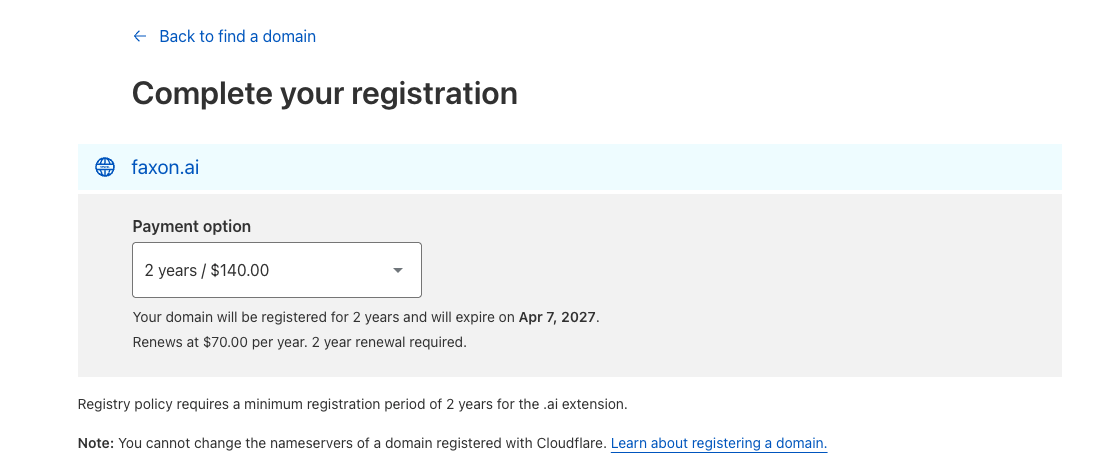
Before I told my audience about the new clone, I bought the domain Faxon.ai. I wanted to make it easy for people to come back to my AI without having to remember a long URL. I used Cloudflare to buy the domain and redirected it to my Delphi clone.
Promoting My Clone
Finally, I started emailing my list about the clone. The main sales argument: there’s a new way to access my expertise, and 50 early adopters will get the lowest-ever price. Here’s the first email I sent:
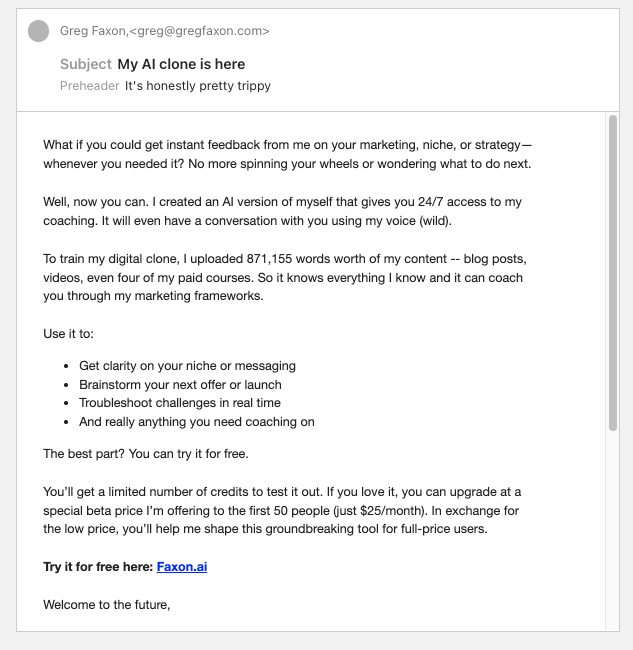
Right away, the replies started rolling in:
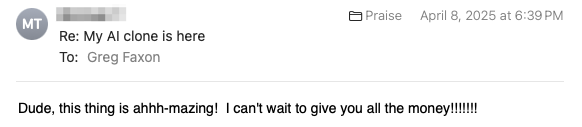

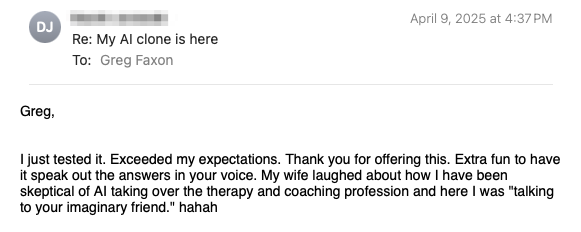
I thought people would use my AI more like a coach — asking strategic questions about their business and having a back and forth conversation. I also thought people would use the voice chat feature more.
I was surprised by how many people used my AI to help them create content. They used it more like a copywriter or creative assistant than a coach, drafting their about page, lead magnet, or workshop outlines.
Not all the feedback was positive. The negative feedback I got fell into two categories: ethical concerns and tech issues. Let’s start with the first group.
A Note on the Ethics of AI
I want to pause here and acknowledge something important:
By choosing to use AI, create a digital clone, and write this article, I’ve made an ethical calculation. I’ve decided that it’s better to be involved in shaping this new technology than to critique it from the sidelines. However, it’s not clear that this is the right choice.
As people have pointed out, there are several ethical concerns with AI. Including:
The environmental impact (which is significant)
The risk of AI diminishing our humanity, or even destroying it
The obvious privacy issue of pouring out your soul to a chatbot
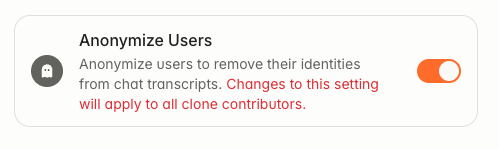
I want to address the third one briefly, because it’s something I’ve had firsthand experience with. By default, Delphi.ai stores the transcripts of users who are logged in along with their names. While these conversations aren’t made public, they are viewable by default to the clone’s creator (me). I eventually went in and changed this setting so that all conversations were anonymous.
Bottom line: we need to approach AI with humility and care. And I’m not sure we can trust tech companies to police themselves in this regard.
Dealing With Delphi
Here were the platform issues that came up after I launched:
First, users were getting confused about the messages quota. In some cases, the paywall would be triggered early when it appeared that they still had free messages remaining. This continued to be a source of frustration for paid members whose monthly usage was late to reset. Delphi’s support team did try to help with this issue, and eventually resolved it after quite a bit of back and forth.
Second, one user got double charged by accident and refunding was a hassle. While users have the ability to cancel a subscription from their account, you have to email Delphi support if someone needs a refund. This seems insane to me and is enough to advise against using Delphi for paid subscriptions. The way that they integrate with Stripe simply doesn’t give you enough control over your subscriptions.
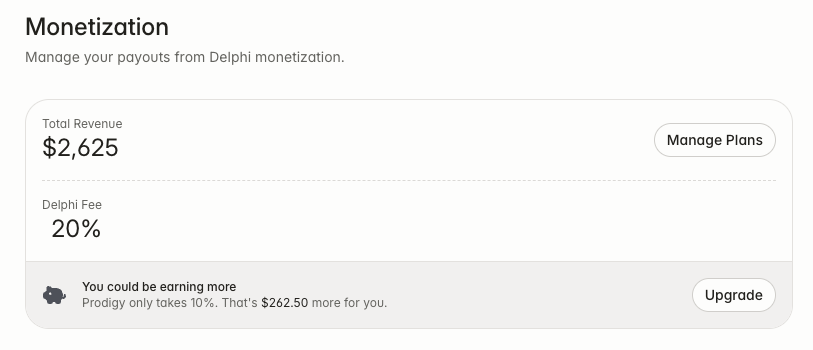
Third, Delphi takes an outrageous cut of subscription revenue. Delphi’s payment processing fee is 20% for most of their plans even though Stripe only charges 2.9%. If you subscribe to Delphi’s Prodigy plan, which costs $399 per month, they only take 10%. Coachvox also takes a 10% cut on all their plans. For this reason alone, I don’t think it’s worth monetizing your clone directly through these platforms.
Despite all of this, I kept plowing forward with the launch. I ended up sending 7 emails over the course of 3 weeks to promote my AI clone. Midway through, I shifted the call to action from the free trial to the paid beta because there was too much confusion around message credits on the free trial.
Here were the emails I sent by subject line:
“My AI clone” (see above) — introduced my clone, CTA for the free trial
“How people are using Faxon.ai” — shared feedback and examples from users
“Faxon.ai vs. ChatGPT” — explained how my AI is different than Chat GPT
“I’m sorry” — shared the tech issues we were having with the platform
“What AI Means For The Future Of Coaching” (see final section of this article)
“Questions People Ask About Faxon.ai” — FAQ format to overcome concerns
“Last call” — Very short email, 3 spots left, final CTA for paid version
The Results

I hit 50 paid users on day 30. A few of those users paid for the annual plan, so I made $1,975 total — minus $395 in Delphi fees — for the first month. I was happy to reach my goal, but surprised by the number of emails it took. My last launch took 5 emails to fill 50 spots for a membership that cost 2-3x more.
After the launch, I followed up twice with my paid users. I wish Delphi made it easier to sync these contacts with my CRM - I had to manually tag each paid user in order to send them welcome emails. So far, there’s been about 12% churn (6 people cancelled in month two). Which gives us an an average LTV of $208 per user.
📊 Quick Stats:
7 emails sent to list of approx. 8,400 subscribers
Email open rates between 38% and 43%
50 paid users reached after 30 days
$1,975 revenue after 30 days
$2,975 revenue after 60 days
12% user churn in first 60 days
My Big Lesson
Use Delphi to create your clone but not to monetize it.
It was easy to create my clone. People love interacting with it. And it’s nice to have $1-2k of passive, recurring revenue.
But it’s not like I’m getting rich off this thing.
When you factor in Delphi’s message quota issues, limitations around subscription management, and large payment fee, I don’t think it’s worth monetizing your AI through them. If I were to do it again, I’d either offer my AI clone for free (and use it as lead gen for my higher end offers) or integrate it into my paid courses. I think those are the main ways that we’ll see AI clones being used in the future.
Which brings us to the final question of this article…
What AI Means for the Future of Coaching
If AI can coach people, what happens to coaches?
Will we all be replaced? Or will we be sitting on the beach sipping margaritas, watching the money roll in?
To answer that question, let me tell you about John Grohol.
***
John was getting his doctorate in psychology when his childhood best friend committed suicide.
It was only his first year of graduate school. John didn't have many friends. So he did something a bit odd for a psychologist-in-training: he turned to the internet.
This was 1990 and there wasn't much mental health support online. Just a few small forums. It was in these forums that John learned about his own depression. Then he started helping others. He developed a list of online resources, and turned that list into a website called Psych Central.
Psych Central hosted content, communities, and (controversially) mental health assessments to help people screen themselves for conditions like ADHD and depression.
That's when the emails started pouring in from therapists:
“It's unethical to diagnose people with an online quiz.”
“It’s going to cheapen what we do.”
“Do you want to put yourself out of a job?”
Back then, therapy happened in person. Period. And most professionals thought John was crazy.
But he kept going.
John wasn't trying to replace therapy. He was trying to reach a new audience, and give those people the courage and resources to seek therapy. People like his childhood friend. He even built a section of the website that helped people find professional help.
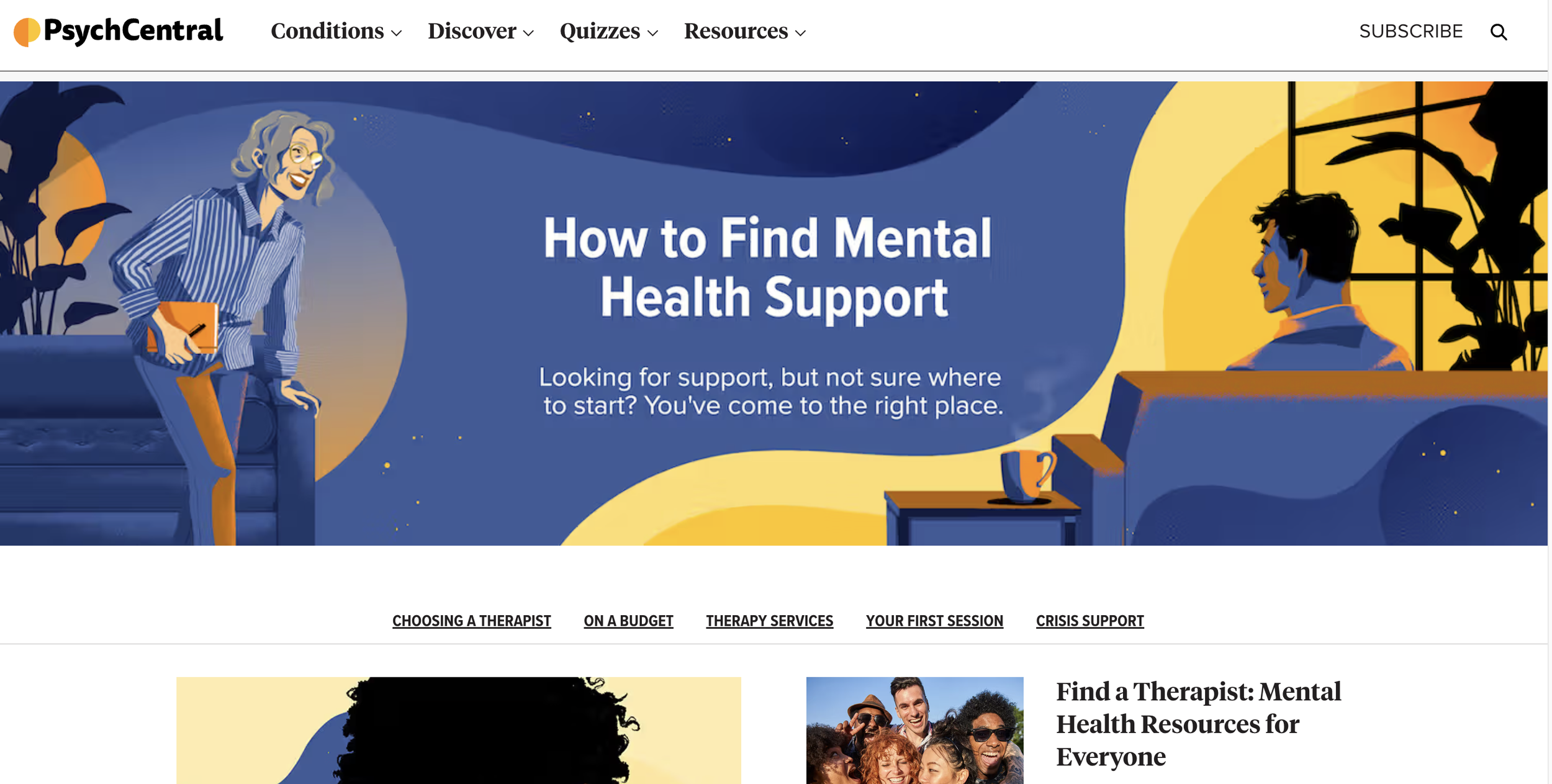
Psych Central would go on to become one of the most visited mental health websites on the internet: 7 million monthly visitors. 250,000 email subscribers. Named one of the Best Websites of the Year by Time magazine.
Finally, in 2020, Psych Central was acquired for millions of dollars by Healthline.
It was the peak of COVID, mental health was at an all time low, and almost every therapist had a full practice.
Two years after the sale, John wrote this on his blog:
“What I’ve learned in these past three decades is that all of these online tools and information help to expose more people to the basic principles of good mental health and introduce them to the idea of getting help for their psychological problems when they arise. They don’t take patients away from therapists. Instead, they expand the population that has access to therapeutic tools and services.”
***
AI today is a lot like the internet was in 1990.
Imagine telling a coach back then, "One day, you'll meet with your clients on Zoom. You'll market to people around the world using blog posts and Instagram reels. You'll sell online courses via automated webinars."
Most coaches wouldn't have believed you. Yet here we are. Using technology that once seemed unthinkable for our profession. And AI is the next frontier.
Are there downsides to this technology? Of course.
Are there ethical and environmental considerations? Yes.
Will it change the industry in ways we can’t predict? Absolutely.
I have plenty of concerns about AI. But I don't see it as a threat to true coaching. I see it as an on-ramp.
True coaching happens in the context of a relationship. It's about communicating to a client, "I see you." AI can say all the right things...but at the end of the day, people know they're talking to a chatbot. And because of this, it’s easy to go in circles with AI. You can't replace the connection and accountability you get with a human coach.
On the other hand, AI can give people access to your perspective 24/7, at a more accessible price point. It offers advice, clarity, and next steps to people who wouldn't have hired you yet anyway. It's not so different from the free marketing content you already put out (just more interactive).
So, what does AI mean for the future of coaching? Here are my predictions:
The average coach will find it harder to stand out as AI increases accessibility. But those who focus on creating deep relationships will continue to thrive.
Smart coaches will use AI to serve more people. They'll see it as a way to put their free content to work and enhance their paid offers.
The truly visionary ones will be like John Grohol. They’ll choose to embrace the future, not fear it — and use technology as a way to express their values, not override them.
What happens next is up to you.
If you want to test out my clone, hit the button below:
