
I Tried Implementing $100M Money Models
A few months ago, I read Alex Hormozi's $100M Money Models. Then I tried applying it to my coaching business.
In this article, I'll share the 10 lessons I took away from the book, how I implemented each one, and exactly how much money I made as a result.
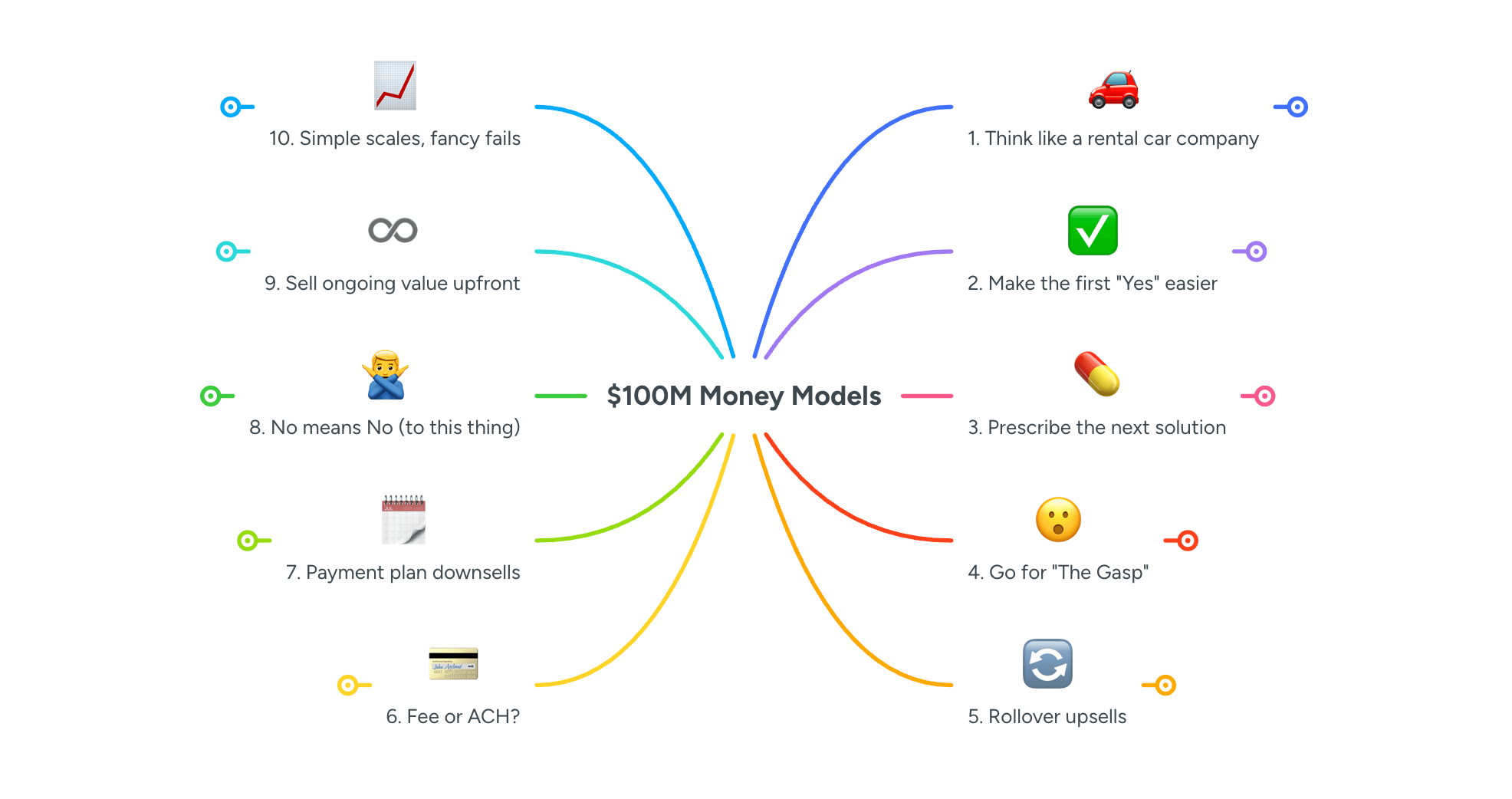
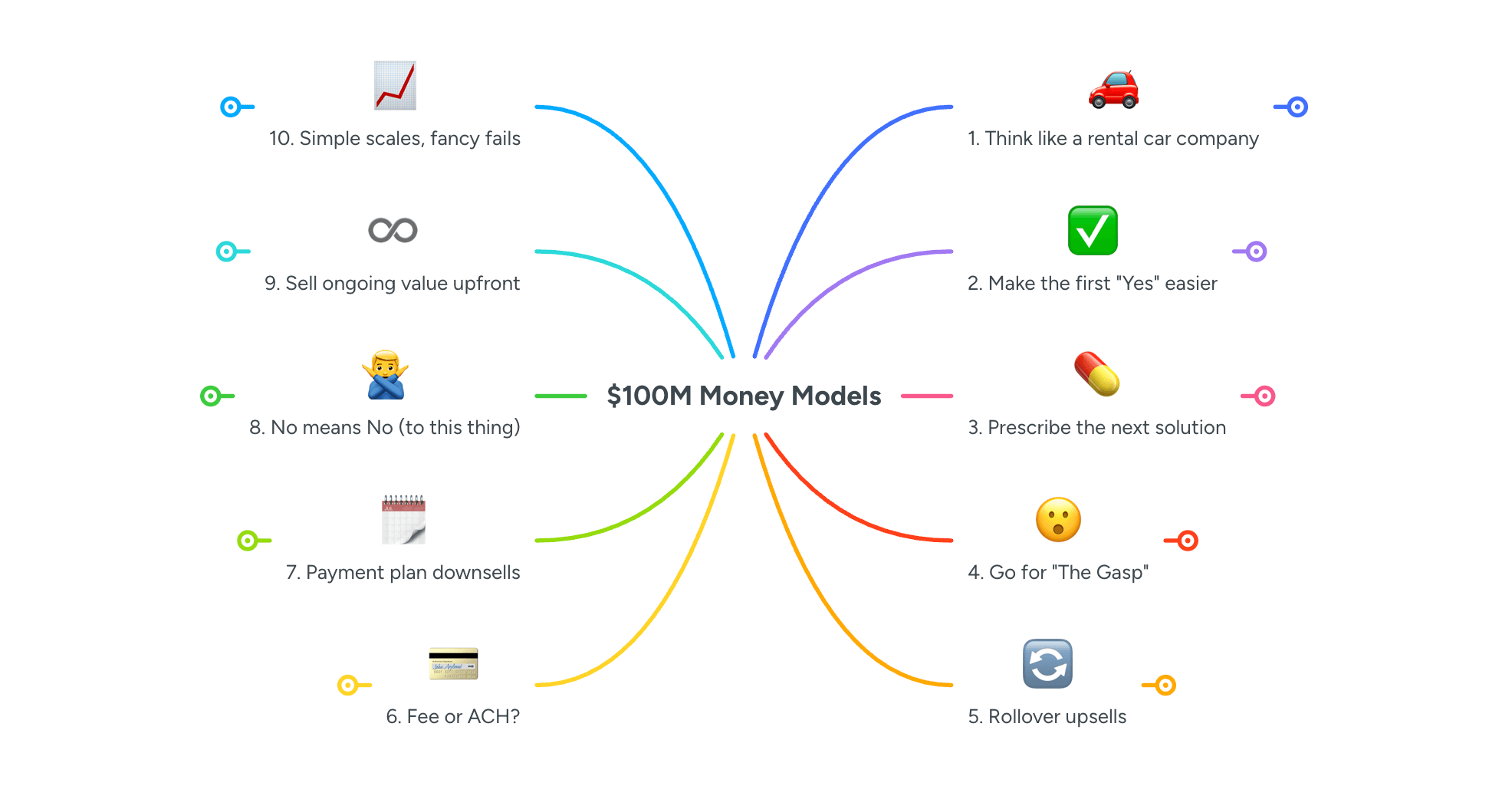
But first - click the button below to get the mind map version of these notes:
Summary
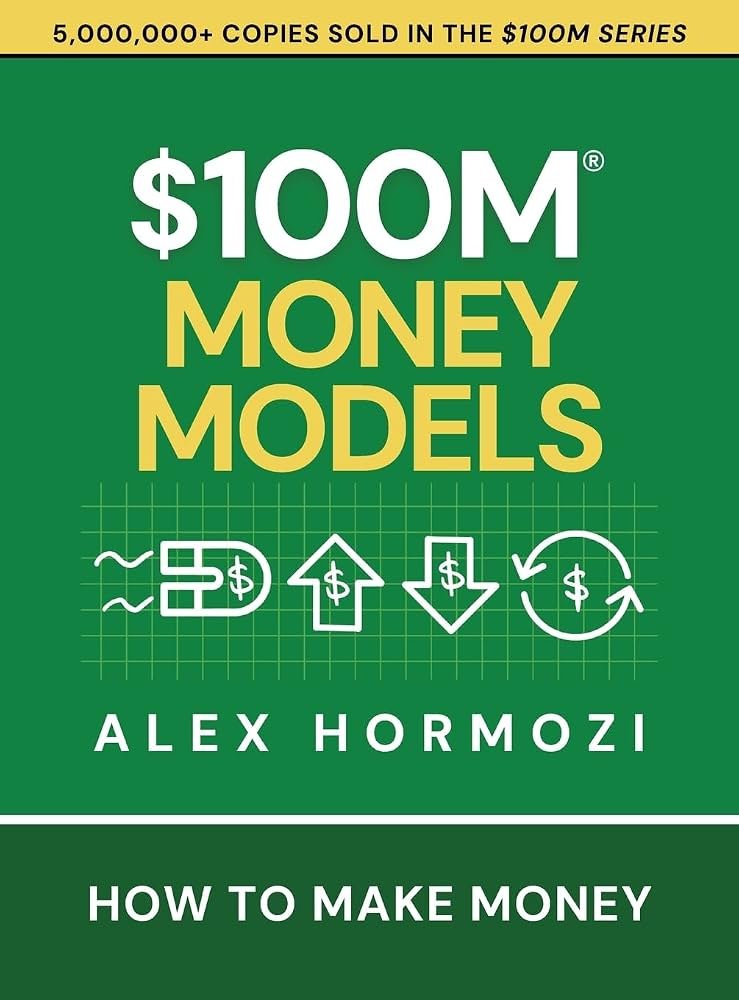
A money model is a sequence of offers that solves customer problems.
A good money model pulls more cash forward into the first 30 days, so you can offset the marketing costs of acquiring a new customer.
Alex Hormozi shares four types of offers in the book: Attraction offers, upsell offers, downsell offers, and continuity offers.
This is the third book in a series. $100M Offers shows you how to create a “grand slam offer” and $100M Leads shows you how to find people to sell it to. Of the three books, this one changed the most about how I actually run my business.
Book Notes
Here are my 10 big takeaways, and how I applied each one.
1 - Think like a rental car company 🚗
Hormozi tells the story of reserving a rental car for $19 a day. But he left having paid $100 a day.
So what happened? They upgraded him from a small car to a truck. They asked if he wanted a later return time. They offered premium insurance. When he said no to that, the minimum insurance added to the daily rate. Then they asked if he wanted to prepay for gas so he wouldn't have to bring the tank back full.
That's a money model. An attraction offer gets you in the door, and then a sequence of upsells and downsells solves additional problems that show up along the way.
Which brings us to the four types of offers described in the book:
Attraction offers - get customers in the door with something free or cheap
Upsell offers - solve the next problem once the first offer has done its job
Downsell offers - sell a lesser version to people who say no to the upsell
Continuity offers - charge for ongoing value after the main engagement ends
Crucially, the offers you create should provide additional value for your clients and customers. Hormozi says he was happy to pay for prepaid gas - it made his life easier.
Now let’s see how I applied each of these offers to my business, starting with an attraction offer.
2 - Make the first "Yes” easier ✅
My client Lisa Higgins is an executive coach. She was one of the first people I offered a 12-month package to instead of 6 months. This was before reading $100M Money Models.
In the first six months of working together, Lisa’s average revenue per month actually went down. But by the end of the year, she had doubled her income. When she left a testimonial for me, she said the best decision she made was working with me for a full year, because it allowed us to set a foundation.
That convinced me to start working with clients for longer. But there's risk on both sides. It's easier to get someone to commit to 6 months than 12 months. And if I get stuck with a client I don't jive with, now I'm in it for a full year.
So how do I lower the risk for both of us?
That's when I came across the idea of attraction offers. Hormozi has a great line about why they work: customers have to take your word on value, but they don't have to take your word on price. If it's affordable, people are more open to getting started.
Hormozi covers several types of attraction offers in the book. For example:
Win your money back - pay for a challenge (e.g. “lose 10 pounds”). If you hit the goal, you get your money back or get a credit towards more of the service.
Giveaways - a grand prize collects qualified leads, then you circle back to everyone who didn't win with a discounted offer.
Buy X, get Y free - a classic promotion that makes you feel like you’re getting a deal. The more things you get for free, the more compelling the offer is.
Hormozi shares more variations (pay less now or pay more later, decoy offers). I’ll let you read the book for those.
First, I tried a giveaway. People filled out a survey for a chance at a free coaching session that would normally be $997, and I circled back to everyone else with a discount. It didn't work at all. Probably because single sessions aren't really my offer anyway, and I didn't put as much thought into it as I could have.
So I built a variation of "win your money back" instead. I called it the Strategy Sprint.
A full year of coaching is around $30k. So I said, okay, let me just sell them the first month for $2,500. I’ll diagnose their business, figure out the main bottleneck, fine-tune the offer, and create a strategy for lead generation.
I sold it to three people using a webinar, some emails to my list, and a few personal reach-outs. It worked! Because of the detailed intake form and the short one-month window, I was able to show up super prepared. And my clients loved it.
3 - Prescribe the next solution 💊
But I didn’t just want month-long clients. I wanted long-term relationships.
So at the end of every Sprint, I created a written brief. I learned this concept from Pia Silva. The brief said, “here’s what’s going on with your business, here's the key decisions we made, and here's what I'd recommend you focus on for the next 90 days.”
Then I booked a short call to go over it with my clients and enroll them in annual coaching. I had solved the first problem (not knowing what to focus on). And now I was solving the next problem, implementation of the plan.
Hormozi calls this prescription upselling: detailed and personalized instructions convert better than broad suggestions. Because of everything I learned in the Sprint, I could make a really specific recommendation instead of a general one.
Upsells are where the money is made. This is the profit center of any business. The idea is for your upsell to solve the new problem created by the attraction offer.
4 - Go for "The Gasp” 😮
A year of business coaching with me is $30k. The Sprint is just $2,500.
So on a sales call I could now say: look, the full journey we've been talking about is probably about a year. But you don’t need to make that decision right now. I think it's better if we start with one month and then talk about whether to continue from there.
Hormozi calls this an Anchor Upsell, and he says it should be 5-10x the price of the basic offer. Being able to name the bigger number gives context to the cheaper one. Without it, $2,500 is just a price.
Ideally, you propose the premium version first and then wait for them to react. Some people will say great, let's go. Everyone else gasps, and then you offer the cheaper alternative. I'm still working on exactly how I propose this on calls and what language converts best.
5 - Rollover upsells 🔄
Last year my bookkeeping company (Bench.co) almost went out of business. You couldn't log into your portal. It was this whole drama. Eventually, it got bought by a new company, but the experience broke trust with me and a lot of other people.
Pilot, another bookkeeping company, recognized everyone was about to go looking for alternatives. So they ran a deal: move to us and we'll credit you for up to 6 months of free bookkeeping or whatever you paid Bench.
A rollover upsell credits the original purchase toward a larger sale. It reframes the new purchase as something they've already started.
That's what the Sprint became for me. At the end of the first month I could say: “Hey, you've just done the first month of a year-long engagement. So I'll give you a credit. It's not the full $30k, it's just $27,500 for the remaining 11 months or $25,000 upfront.”
This allowed me to enroll two Sprint clients for the full year upfront.
6 - Fee or ACH? 💳
You're going to have credit card processing fees anyway, so Hormozi says you may as well state your price with the fee attached. E.g. “It's $x plus a 3% processing fee.”
I felt conflicted on this one, because I'm always annoyed when businesses charge me for processing. That's just the cost of doing business, especially online. But he says he's never had someone not buy because of a processing fee.
So here's what I ended up doing. The $2,500 Sprint just goes on a card. For the year, you can pay by card and cover the 3%, or pay by ACH and I'll waive it. On a $25k payment, 3% takes a real chunk out.
Now I'm saving money on fees and I have a second form of payment on file.
7 - Payment plan downsells 🗓
When most of us think about downsells, the first thing we think about is changing the product itself. But you can downsell just by changing how people pay.
There's a specific order, and you go down the list until you get a yes. Don’t present the whole menu up front. Here is what Hormozi teaches:
Upfront with a discount. $30k, or $27,500 if you pay in full. Reward paying in full rather than punish paying over time by stating the larger price first. After the Sprint credit applied, this was $25k.
Financing, credit card, or layaway. Ask, “Do you want to decide the payment plan or do you want me to decide.” Most people would rather decide, and you can tell them to use a credit card. You can also explore 3rd party financing or layaway.
Half now, half later. Note this now equals the full $30k, not the discounted price.
Check if they still want it. Ask, “On a scale of 1-10, how much of a priority is this?” An eight or above means you keep going.
Three payments. You can do this to align with their paycheck cycle or spread them evenly across the engagement.
Evenly spread monthly payments.
Why try and collect more cash up front instead of just going straight to monthly? Because churn decreases as payment lengths increase. Hormozi cites research from ProfitWell:
| Billing frequency | Monthly cancellation rate |
|---|---|
| Monthly (12x per year) | 10.7% |
| Quarterly | 5% |
| Annual | 2% |
Why is churn higher with more frequent payments?
One reason for this is called the Lookback window. If I pay once a year, I look back at the whole year and everything that changed. If I pay monthly, I'm only looking back 30 days. Hopefully that month of coaching went well and you made money. But if it didn't, you start wondering if this is really worth it, because you have to keep remaking the same decision.
More frequent charges also mean more declined payments.
One thing to watch: your conversion rate should increase when you add payment plans, but your pay-in-fulls should stay the same. If people who would have paid upfront are now taking a 12-payment plan and canceling halfway through, you've lost money. Offering payment plans didn't help your business.
8 - No means no (to this thing) 🙅♂️
A lot of times when you hear no, they're saying no to the current scope. They might say yes to a different version. With payment plan downsells we were lowering how much they pay upfront. With Feature downsells we lower the overall cost.
Feature downsells discount by changing the scope. Hormozi has a funny line about never negotiating with “business terrorists.” You can lower the price, but only if you remove elements.
The interesting thing is that downselling gets people to re-upsell themselves. Say you offer to knock $2,000 off by removing a guarantee. Now that you're talking about removing it, they can see why it's valuable. So they pay the higher price to keep it.
For my 1-1 coaching, that could mean fewer calls, fewer months, no email support between calls, etc. Instead of lowering my price arbitrarily, which takes away credibility, I'm just removing features.
My idea for this came from my client Lisa (again). At the end of her year-long program, she said she didn't need the same level of implementation, but she didn't want to let go of the relationship either. I know a lot about her business now, and she valued having that perspective when setting quarterly priorities.
So I offered quarterly planning. One call per quarter, no between-call support. She sends me her metrics, I look at what she's got going on and make sure she's focused on the right things, and we set goals together. It’s just $1,500 per quarter, or $6k upfront.
9 - Sell ongoing value upfront ♾️
Recurring revenue is great, but you get less cash in the short term. So how do you get more of it up front? You give people an incentive.
Continuity discount - sign up for 12 months, get one free
Continuity bonus - commit to a longer term, get something extra
Waived setup fee - roll the onboarding fee into a longer commitment, and charge a cancellation fee if they leave early
I've offered quarterly planning to three clients so far. Interestingly, two of the three paid $6k upfront even though there was no discount. I think they wanted to expense it before the end of the year, so the incentive might have been built in. We'll see if I get the same spread mid-year.
If not, maybe I'll discount the upfront payment, or add a bonus. Something like an annual review where we zoom out at the end of the four quarters and figure out the lessons and the priorities for next year.
10 - Simple scales, fancy fails 📈
This is probably my favorite quote in the book: “It's less about having a hundred different products with the same offer, and more about having a hundred different offers for the same product.”
My business before I read this book was pretty complex. Every time I needed cash I'd launch something new to the same audience - group programs, online courses, a membership - and every time I did that it created complexity.
I did an 80/20 analysis. 80% of my profit came from 1-1 coaching. So I cut away everything else.
It was scary at first, but it really simplified my business and helped me make my core service better.
In total, these 10 lessons made me an additional $114k.
| Offer | Type | Clients | Result |
|---|---|---|---|
| Strategy Sprint ($2,500) | Attraction + anchor upsell | 6 | $14,500 |
| Annual coaching ($30k) | Rollover + prescription upsell | 2 | $50,000 |
| Annual coaching, financed | Payment plan downsell | 2 | $31,000 |
| ACH instead of card | Fee savings | 3 | $1,445 |
| Quarterly planning ($1,500/qtr) | Continuity + feature downsell | 3 | $18,000 |
| Total | $114,945 |
If you want help fine-tuning your own money model - what the attraction offer is, what the upsell solves, how to get paid more upfront - apply to work with me here.
Or, if you want to implement the lessons on your own, use my mind map.
Frequently asked questions
What is a money model?
A money model is a sequence of offers that solves customer problems. A good one pulls more cash forward into the first 30 days so you can afford to keep acquiring customers. It's built from four offer types: attraction, upsell, downsell, and continuity.
What is an attraction offer?
An attraction offer gets customers in the door by offering something free or cheap. Examples include win-your-money-back challenges, giveaways, buy-one-get-one deals, and productized first engagements like a paid diagnostic month.
What is prescription upselling?
Prescription upselling means giving a specific, personalized recommendation for what someone should do next, based on what you learned while working with them. Detailed instructions convert better than broad suggestions.
What is a rollover upsell?
A rollover upsell credits the original purchase toward a larger sale. Crediting a $2,500 first month against a $30,000 year makes the year $27,500 and reframes it as something the client has already started.
In what order should you offer payment plans?
In descending order, stopping when they say Yes. Pay in full with a discount, then financing or credit card, then half now and half later, then three payments, then monthly. Presenting the whole menu at once costs you cash you didn't need to give up.
Does annual billing reduce churn?
Yes. Alex Hormozi cites ProfitWell data which shows about 10.7% monthly cancellation for monthly billing, 5% for quarterly, and 2% for annual. The longer the gap between payments, the more results someone looks back on when deciding whether it was worth it.
Do I need a money model if I’m a solo coach or consultant?
Your business already has a money model. A good money model makes your business simpler and more profitable. One core service with a good attraction offer, a clear upsell, and a continuity offer beats four disconnected products you have to keep launching.
