
How To Find A Business Coach That Doesn’t Suck
You've seen the ads. The Stripe dashboard screenshots. The testimonials claiming "I went from $0 to $47k in 90 days."
Feeling skeptical?
Good. You should be.
I say this as someone who's coached entrepreneurs for over a decade and spent over $100,000 on my own coaches:
Your goal isn't simply to "find a business coach."
Your goal is to find the right kind of support for the problem you're trying to solve.
This article will show you how to do that. Here’s an overview of the process:
But first…
What does a business coach actually do?
A business coach helps entrepreneurs reach their goals faster by focusing on the right things, making better decisions, and following through.
"Business coach" is a broad term, though.
Some business coaches are basically consultants. Some are mentors. Some are expensive accountability buddies with fancy branding.
The issue is when you don't know what you're buying.
If you hire a business coach because you want to see your blind spots, great.
If you hire a coach because you want someone to build your funnel, write your content, or manifest your way to 7 figures…well, you may be disappointed.
It doesn't mean business coaching is a scam. You just hired the wrong kind of help.
Step 1: Name the problem you’re trying to solve
Before you hire anyone, figure out why you want a coach.
"I need help with my business" is not enough.
Are you having trouble getting leads?
Are your leads not converting?
Are you working 60-hour weeks and starting to miss your old boss?
You want a coach who can help you identify and solve the real bottleneck in your business. Not someone who automatically prescribes their favorite solution. For example, everyone thinks that they just need more leads but it’s almost never that simple. Often the deeper problem is their offer, pricing, or positioning.
Different problems require different solutions.
If your books are a mess, hire a bookkeeper. If you need legal advice, hire a lawyer. If you need someone to run your ads, hire an ad agency.
A business coach can help you see what needs to happen next. But they can't do it for you. They cannot make the sales call, publish the article, raise your prices, or have the hard conversation with a difficult employee.
What Kind of Help Do You Need?
→ Hire a 1-1 business coach with relevant experience
→ Hire a consultant, freelancer, or agency
→ Join a mastermind or group coaching program
→ Start with books, courses, or workshops
Business coaching works best when 3 things are true:
1 - You're honest about what the real problem is.
2 - The coach's expertise matches your problem.
3 - You're willing to implement what you discuss.
Without those 3 things, coaching is just you talking about the same problems week after week.
Step 2: Decide what type of coaching you can afford
Think of hiring a coach the way you'd think about making any investment.
The question isn't "will coaching be expensive?" Because yes, good coaching is expensive.
The question is: what problem am I hiring this person to help me solve, and what would solving that problem be worth?
Will a business coach make you more money?
It depends.
Let's say your business is stuck at $10k/month. You think that better positioning, a stronger offer, and a higher-converting sales process could get you to $20k/month. Well, the ROI of that fix over 12 months would be $120,000.
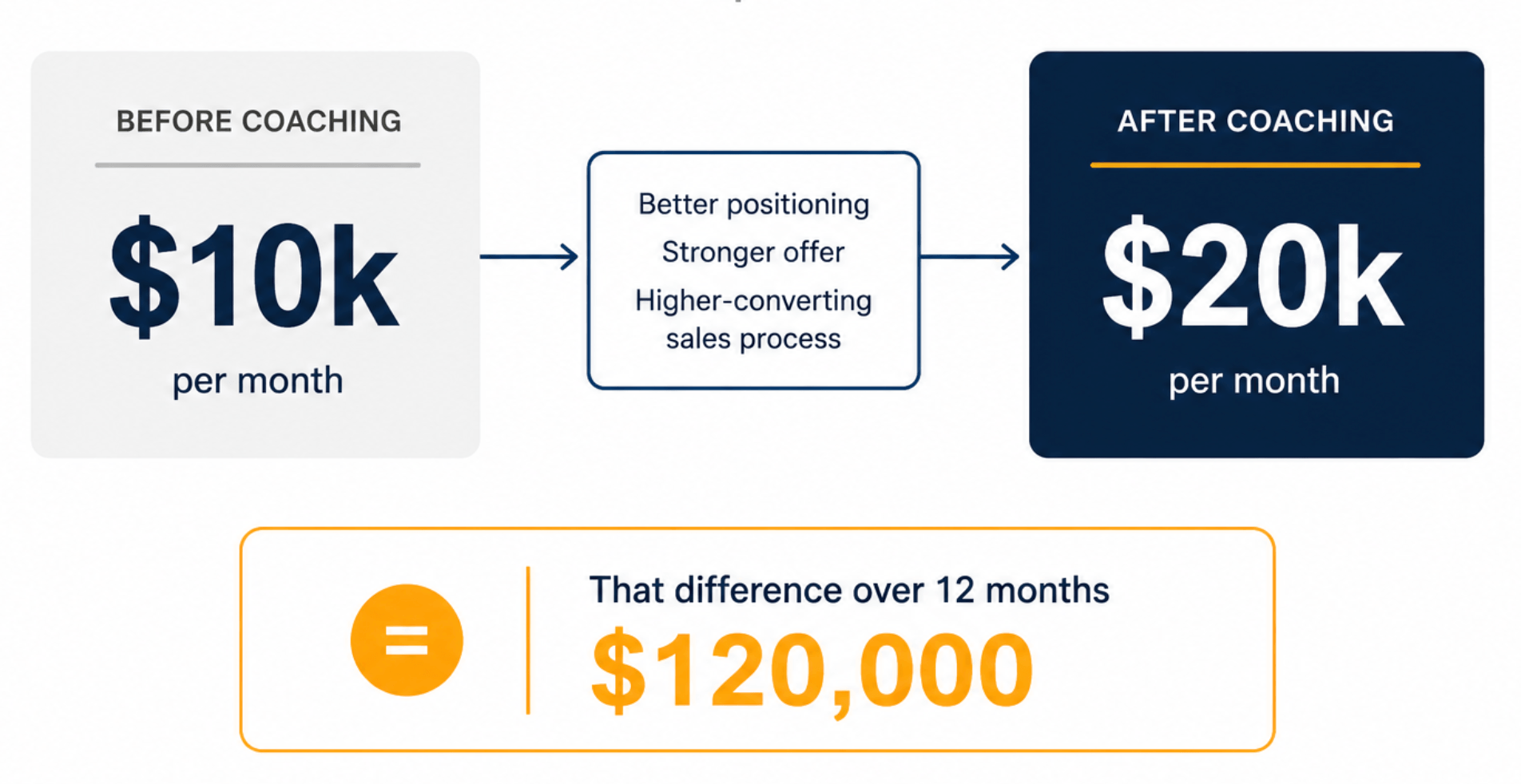
On the other hand, if you're pre-revenue and unclear on what you want to sell, an expensive 1:1 coach may not be the right move. It will take too long for you to see a return on that investment because there's foundational work to do. In this case, investing in an online course or affordable group program might make more sense.
Does coaching actually work? See what my clients have achieved.
How much should a business coach cost?
Business coaching ranges from free support through local small business organizations all the way to high-end packages of $50,000+.
| Type of Business Coaching | Typical Cost |
|---|---|
| Free nonprofit mentoring (e.g. SCORE) | $0 |
| Online courses with limited interaction | $100–$2,000 |
| Premium 1-on-1 or small group coaching | $1,000–$5,000/month |
The cost only makes sense in context. A $500 online course can be expensive if nothing changes. A $25,000 private engagement can be cheap if it helps you fix a problem worth hundreds of thousands in revenue.
For obvious reasons, the price will generally be higher for 1-1 coaching than group coaching or courses. Note that some of the best coaches charge upfront for 3, 6, or 12 month packages instead of going month to month. And often, it’s worth paying a bit more to access these folks.
I’m not saying you should automatically hire the most expensive coach you find. Please don’t do that. Tony Robbins famously charges his private clients over $1m per year, but I’m not convinced he brings 100x more value than someone who charges $10k.
Step 3: Find a few coaches who match your situation
A business coach is only worth paying for if their expertise matches the problem you're trying to solve. Here are the most common types.
Business coach for small businesses
Helps owner-operated businesses with growth, operations, hiring, and profitability. Most useful when the business is working but the owner has become the bottleneck. Often associated with established, local businesses versus online startups.
Business coach for entrepreneurs
Helps founders think through offers, business models, marketing, and scaling. In practice, there's a lot of overlap between this and the category above. The distinction is mostly about how you think of yourself rather than the actual work involved.
Business coach for a specific type of business
Some coaches work exclusively with one type of client: real estate agents, medical practices, creative agencies. The narrower the niche, the more specific the advice. For example, I’m a business coach for coaches, consultants, and other service-based businesses.
Specialist coach (e.g. marketing coach)
Not coaching the whole business, just one function. Best when your problem is clearly isolated. Some coaches specialize in a specific type of client and a specific problem. For example, my focus is client acquisition.
The more specialized the coach, the more targeted the advice tends to be. And the faster you'll see results.
A quick note: this guide is specifically about business coaches, not life coaches (who take a more holistic approach) or executive coaches (who work with leaders of large organizations).
Want to skip the search entirely?
If you're already getting clients but want a simpler, more predictable way to grow, apply for a Strategy Session and we’ll see if I'm the right fit.
Where to find a good business coach
Google and AI tools are a solid starting point. But look beyond whoever ranks first or ChatGPT recommends by default. Read their case studies. See if their expertise actually maps to your problem.
Referrals are often your best bet. Ask other business owners in communities you're a part of: "Have you worked with a coach who helped you grow?" Specific referrals are gold if you can get them.
Free content is a good filter. A coach's blog, podcast, or newsletter gives you a preview of how they think. Do they demonstrate a nuanced understanding of their specialty? Or do they just say "charge your worth" again and again until everyone in the room loses consciousness?
Live events and paid communities are underrated. These can be surprisingly good places to find coaches. The best coaches aren’t spending all day on social media. They’re quietly building their reputation at workshops, masterminds, industry conferences, and in other people’s Slack groups.
Step 4: Have a conversation before you hire them
You found a coach online or got a recommendation. You like the person's website.
Great. But liking someone's website isn't the same as knowing they can help you.
Most coaches will offer a complimentary consult or "strategy session." Schedule it. A good coach will ask you plenty of questions during this call. You should also ask some of your own.
5 questions to ask before hiring a business coach
1. How do you define success in your own business?
This tells you what the coach values. Do they define success by client results? Revenue? Freedom? Lifestyle? There's no perfect answer — but if their definition is different from yours, slow down. You're hiring someone's judgment. Their values shape that judgment.
2. What kind of clients do you love working with and why?
You want to hear yourself in their answer. Not in a forced, salesy way. In a "this person understands my situation" way. If they work with everyone and can't describe a specific type of person, that might be a reason to pause.
3. What measurable results have you helped people like me achieve?
Case studies don't guarantee you a result. But they show you how the coach has been useful before. If you want more consistent clients, have they helped someone improve lead flow or conversion? If you want more profit, have they helped someone increase pricing, margin, or retention?
4. What's your greatest strength as a coach?
Some coaches are great at strategy. Some at accountability. Some at sales. Some at mindset. There's no right answer. What matters is whether their strength addresses your need. If you're already highly strategic but struggle to execute, you may need structure and accountability more than another pile of frameworks.
5. What does your gut say about how well we'd work together?
This one feels weird. Ask it anyway. You're not buying information. You're entering a working relationship. If a coach gives anything less than an enthusiastic yes, explore that before you sign anything. If they don’t think you’d be a good fit, ask them if they can refer you to another coach.
| Red Flags | Green Flags |
|---|---|
|
They promise revenue results.
Business coaches can influence outcomes, but they can’t fully control what you do.
|
They know who they help best.
Honest coaches are clear about the types of clients and problems they’re best suited for.
|
|
Their advice is one size fits all.
Not just “run a webinar.” Good coaches adapt to your goals, strengths, and stage.
|
They use a diagnostic approach.
They focus on identifying the highest-leverage opportunity for you right now.
|
|
Their testimonials are vague.
Look for measurable business outcomes versus “I’m way more confident now!”
|
They can provide case studies.
They should have examples of clients they’ve helped who are similar to you.
|
Make a decision on who to hire
At a certain point, you need to stop researching and make a call.
You’re not trying to identify the single greatest coach on earth. You’re trying to find someone who understands your goals, has a good track record, and feels like a fit for this season of your business.
Once you’ve found someone who meets those criteria, it’s better to write the check and start getting coached. There’s no point spending three months researching business coaches instead of actually working on your business.
If you’re talking to multiple coaches, it can help to compare them side-by-side instead of relying entirely on emotion and going with whoever had the slickest sales pitch. Here’s a simple scorecard you can use:
| Criteria | Question to Ask | Y/N |
|---|---|---|
| Experience | Do you trust their expertise for your situation? | Y/N |
| Methodology | Did they clearly explain their approach? | Y/N |
| Results | Do they have good reviews + case studies? | Y/N |
| Chemistry | Do you enjoy talking to them? | Y/N |
| Sales Process | Did they guide you instead of pressure you? | Y/N |
| ROI Potential | Could the coaching realistically pay for itself? | Y/N |
Is business coaching worth it? (My honest answer)
It can be, but only under the right conditions.
The best coaches I’ve hired all had one thing in common: their expertise matched the specific problem I was trying to solve at that moment.
The ones that felt like a waste of money? I hired them for the wrong reasons. I liked their branding, envied their success, or just had a vague sense that I "needed help."
A business coach is worth paying for when:
Your business already has some traction
You've identified a specific problem you need guidance on
You're willing to implement the solution
It's probably not the right investment if:
You're pre-revenue and still figuring out what to sell
You just need to hire someone else to execute
You're not willing to get outside of your comfort zone
That last point is worth emphasizing. The results you get from business coaching depend primarily on how you show up to the sessions and the actions you take in between. Not just on who you hire.
Want help finding the real bottleneck in your business?
A bad business coach will sell you a generic system, a motivational pep talk, and an expensive weekly therapy session disguised as a business expense.
A good one will help you see the bottleneck you've been too close to notice.
Obligatory pitch from the coach who wrote this:
If you've read this far, you probably have a sense of what to improve. You just need some outside perspective. I may be able to help.
My work is best suited for coaches, consultants, and other service-based business owners. They’re getting clients but want simpler, more predictable growth. That usually means tightening their positioning, strengthening their offer, or fixing their marketing and sales process so they can make more money from their expertise.
The next step is to apply for a Strategy Session. On the call, we’ll identify your main bottleneck. Then I’ll either describe what working together would look like or point you toward someone better suited to help. I know a lot of coaches.
